B.Tech in Electronics & Telecommunication Engineering is a four-year undergraduate engineering programme that combines electronics, communication systems, embedded technology, semiconductor devices, signal processing, wireless communication, networking and modern digital technologies. The course prepares students for careers in VLSI and semiconductor design, embedded systems, IoT, telecommunications, 5G, RF engineering, robotics, electronics product development and technology-driven industries. Salary should be presented as indicative. Current India salary data varies substantially by role and experience; for example, Indeed reports an average Electronics Engineer base salary of about ₹21,725/month in India, while published Electronics & Telecommunication Engineer salary data shows a broad ₹1.1–₹6 LPA range depending on experience and employer.
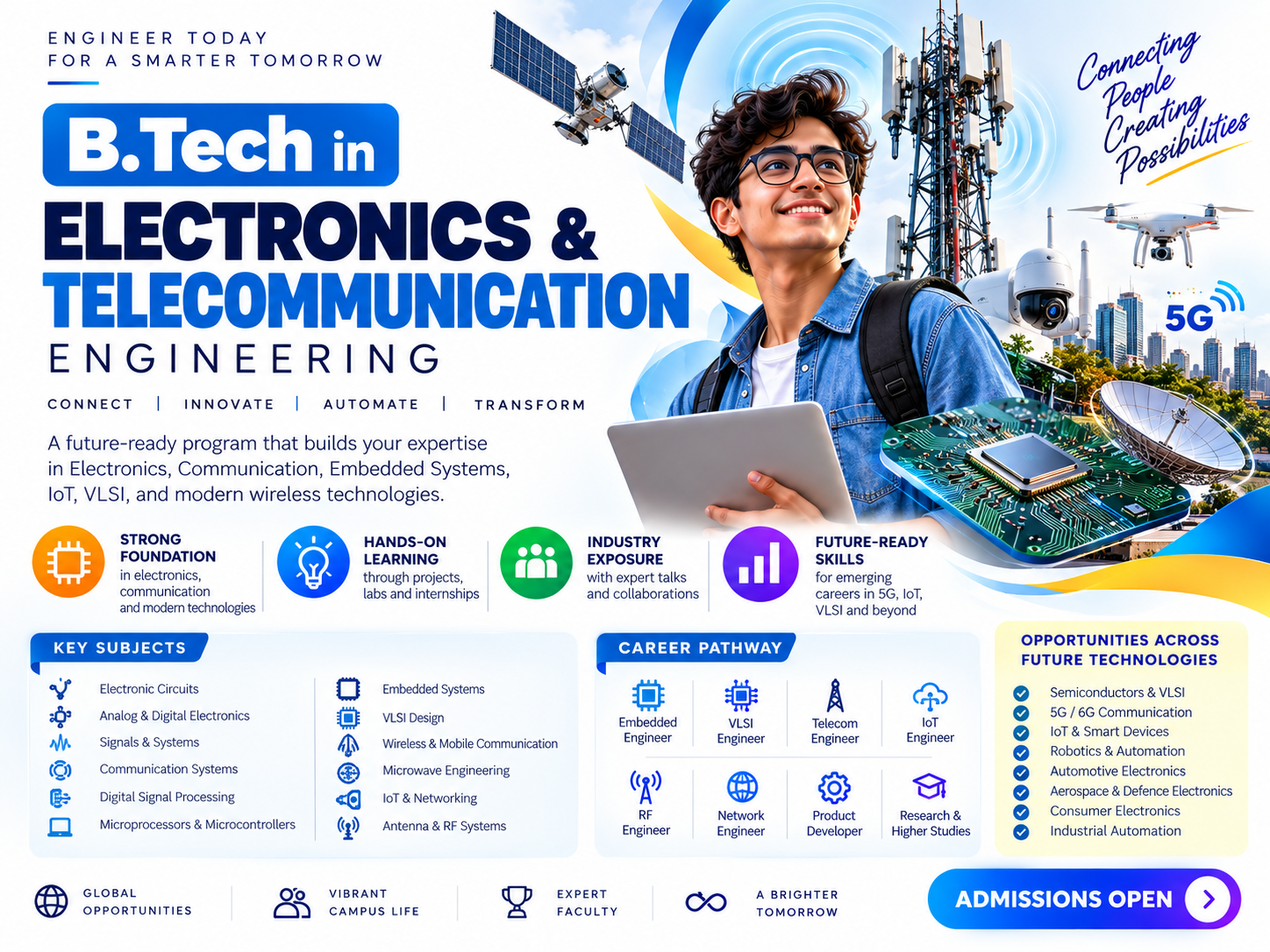
B.Tech in Electronics & Telecommunication Engineering (ETCE) is a four-year undergraduate engineering programme that combines electronics, communication systems, semiconductor technology, embedded systems, signal processing and modern telecommunications.
The programme prepares students to design, develop and test electronic and communication systems used in smartphones, wireless networks, IoT devices, automobiles, satellites, industrial automation, medical equipment, defence systems and modern digital infrastructure.
Electronics and Telecommunication Engineering sits at the intersection of electronics, communication and computing. Students learn how electronic circuits are designed, how information is transmitted, how signals are processed and how hardware and software work together inside intelligent devices.
The course begins with engineering mathematics, physics, programming and electrical/electronic fundamentals and progressively moves into digital electronics, analog circuits, microprocessors, communication systems, digital signal processing, embedded systems, VLSI, wireless communication, microwave engineering and networking.
With appropriate electives and projects, students can also move towards emerging areas such as semiconductor technology, IoT, robotics, automotive electronics, artificial intelligence, 5G/6G communication and edge computing.
Learn both electronic hardware and communication technologies, giving you a broad engineering foundation.
Build a pathway towards VLSI, chip design, semiconductor engineering, verification and electronics manufacturing.
Learn how hardware and software work together inside smart devices, automobiles, industrial systems and consumer electronics.
Explore wireless communication, RF systems, mobile networks, antennas and modern telecommunications.
Develop connected devices by combining sensors, microcontrollers, communication networks and software.
Graduates can pursue electronics, telecom, semiconductor, embedded, IoT, networking, automation and software careers.
The exact syllabus varies by university, but a typical Electronics & Telecommunication Engineering programme covers the following core subjects.
Calculus, differential equations, linear algebra, probability, statistics and mathematical methods used in engineering and signal processing.
Learn programming and computational problem solving using languages such as C, C++, Python or Java.
Study diodes, transistors, amplifiers, semiconductor devices and fundamental electronic circuits.
Learn analog circuits, amplifiers, oscillators, operational amplifiers and electronic signal conditioning.
Study logic gates, Boolean algebra, combinational circuits, sequential circuits, counters and digital system design.
Understand continuous and discrete signals, systems, transforms, convolution and system analysis.
Learn how information is transmitted through wired and wireless communication systems.
Study digital signals, filtering, transforms, sampling and practical signal-processing applications.
Learn processor architecture, microcontrollers, interfacing, programming and hardware control.
Learn how software and hardware are integrated to create intelligent embedded devices.
Introduction to integrated circuit design, digital hardware design, verification and semiconductor technologies.
Study electromagnetic fields, wave propagation, transmission and their applications in communication systems.
Explore microwave devices, transmission lines, waveguides, antennas and high-frequency systems.
Learn fibre-optic communication, optical sources, detectors and high-speed data transmission.
Study cellular systems, wireless channels, modulation, multiple access and modern mobile communication technologies.
Understand network architecture, protocols, switching, routing and modern telecom infrastructure.
Learn sensors, microcontrollers, connectivity, cloud integration and intelligent connected devices.
Learn networking fundamentals, protocols, communication architectures and network security.
Chip design, digital design, verification, FPGA, semiconductor devices and IC technologies.
Microcontrollers, embedded C/C++, RTOS, firmware, sensors and hardware-software integration.
Antennas, RF systems, microwave engineering, wireless communication and mobile networks.
Connected sensors, smart devices, edge computing, communication protocols and cloud integration.
Cellular technologies, wireless systems, network architecture and next-generation communication.
Combine electronics with AI, edge intelligence, robotics and intelligent automation.
Electronics and Telecommunication Engineering is strongly application-oriented. Students can gain practical experience through laboratory work, hardware projects, simulations, internships and industry-oriented final-year projects.
Build an IoT-based system to control appliances using sensors, microcontrollers and wireless connectivity.
Develop a sensor-based system that collects and transmits environmental data.
Build a connected system for monitoring selected health parameters using sensors and communication.
Design an autonomous or remotely controlled robot using microcontrollers and sensors.
Implement digital hardware systems using FPGA and hardware description languages.
Build and analyse a wireless communication prototype using appropriate RF or communication modules.
One of the biggest advantages of Electronics & Telecommunication Engineering is the flexibility to choose between core electronics, semiconductor, communication, embedded, IoT, automation and software-oriented careers.
B.Tech ETCE → Digital Electronics → Verilog/VHDL → VLSI → FPGA → Verification / Design → VLSI Engineer → Senior Design Engineer → Architect
B.Tech ETCE → C/C++ → Microcontrollers → Embedded C → RTOS → Projects → Embedded Engineer → Senior Embedded Engineer → Embedded Architect
B.Tech ETCE → Communication Systems → Networking → Wireless Communication → RF / Telecom → Telecom Engineer → Network Engineer → Senior Telecom Specialist
B.Tech ETCE → Sensors → Microcontrollers → Embedded Systems → IoT Protocols → Cloud Integration → IoT Engineer → IoT Architect
B.Tech ETCE → Signals & Systems → Electromagnetics → Antennas → Microwave / RF → RF Engineer → Senior RF Engineer → RF Specialist
B.Tech ETCE → Circuit Design → PCB → Embedded Systems → Testing → Electronics Design Engineer → Product Engineer → Product Lead
B.Tech ETCE → Programming → Data Structures → Development Skills → Projects → Software Engineer → Senior Software Engineer → Tech Lead
B.Tech ETCE → Electronics → Sensors → Microcontrollers → Control Systems → Robotics → Robotics Engineer → Automation Specialist
Graduates can work in semiconductor companies, electronics manufacturers, telecommunications companies, automotive companies, consumer electronics, defence, industrial automation, networking, IT services and technology startups.
Design, test and maintain electronic circuits, systems and products.
Develop firmware and hardware-software systems for embedded products.
Work on integrated circuit design, verification, FPGA and semiconductor technologies.
Verify digital hardware designs using simulation and hardware description languages.
Work on telecommunications infrastructure, networks and communication systems.
Design, test and optimise RF and wireless communication systems.
Configure and maintain communication and computer networking infrastructure.
Develop connected devices combining sensors, electronics, communication and software.
Design electronic boards, circuits and hardware products.
Design and develop printed circuit boards for electronic products.
Develop electronic and control systems for industrial automation.
Work in semiconductor design, manufacturing, testing and related engineering operations.
Design electronics, control systems and embedded technologies for robotic systems.
Develop systems for processing audio, video, communication and sensor signals.
Work across hardware, software and communication systems in enterprise environments.
ECE graduates with strong programming and software skills can also enter software and IT careers.
Salary varies significantly according to job role, technical specialisation, experience, location, company and industry. The figures below should therefore be treated as indicative career ranges rather than guaranteed placement packages.
| Career Stage | Typical Experience | Indicative Salary |
|---|---|---|
| Entry Level / Fresher | 0–2 Years | ₹2.5 – ₹5 LPA |
| Skilled Engineer | 2–4 Years | ₹4 – ₹8 LPA |
| Mid-Level Engineer | 4–7 Years | ₹7 – ₹14 LPA |
| Senior Engineer | 7–10 Years | ₹12 – ₹22 LPA+ |
| Lead / Specialist / Architect | 10+ Years | ₹18 LPA+ |
Circuit design, testing, product development and electronics engineering roles.
Embedded C, microcontrollers, firmware, RTOS and hardware-software integration.
Digital design, verification, FPGA and semiconductor engineering can lead to specialised opportunities.
Telecom infrastructure, wireless networks and communication systems.
Connected devices, sensors, embedded systems and IoT platforms.
RF systems, antennas, microwave engineering and wireless communication.
ECE graduates with strong programming, DSA and software development skills can enter IT careers.
Semiconductor design, testing, manufacturing and related technology roles.
Specialise in VLSI, Embedded Systems, Communication, Signal Processing, RF, Microelectronics or related fields.
Pursue advanced studies in electronics, semiconductor, communication, robotics or computer engineering.
Build advanced expertise in VLSI, chip design, verification and semiconductor technologies.
Move towards technology management, product management, consulting and business leadership.
Suitable for students interested in advanced electronics, communication, semiconductor research and academia.
Students can build specialised skills through certifications in embedded systems, networking, cloud, cybersecurity, VLSI and related technologies.
ETCE graduates can also explore engineering and technical opportunities through competitive examinations and recruitment processes conducted by government departments, public-sector organisations, defence organisations, telecommunications organisations, railways and research institutions, subject to the eligibility rules of each recruitment.
Mathematics, Physics, programming, electrical fundamentals, basic electronics and engineering laboratory skills.
Analog and digital electronics, signals and systems, microprocessors, communication systems and circuit design.
Explore VLSI, embedded systems, IoT, RF, wireless, telecom, robotics or software development.
Internship, advanced projects, certification, placement preparation and final-year project.
The field is evolving beyond traditional electronics and telecommunications. Semiconductor manufacturing, connected devices, autonomous systems, electric vehicles, industrial automation, robotics, 5G/advanced wireless communication, edge computing and intelligent electronics are creating new areas for engineers with strong electronics and computing skills.
From semiconductor chips and embedded systems to 5G networks, IoT devices and intelligent electronics, Electronics & Telecommunication Engineering gives students the foundation to build and connect the technologies of the future.
Explore Admission