Power & Energy
Understand how electricity is generated, transmitted, distributed and managed.
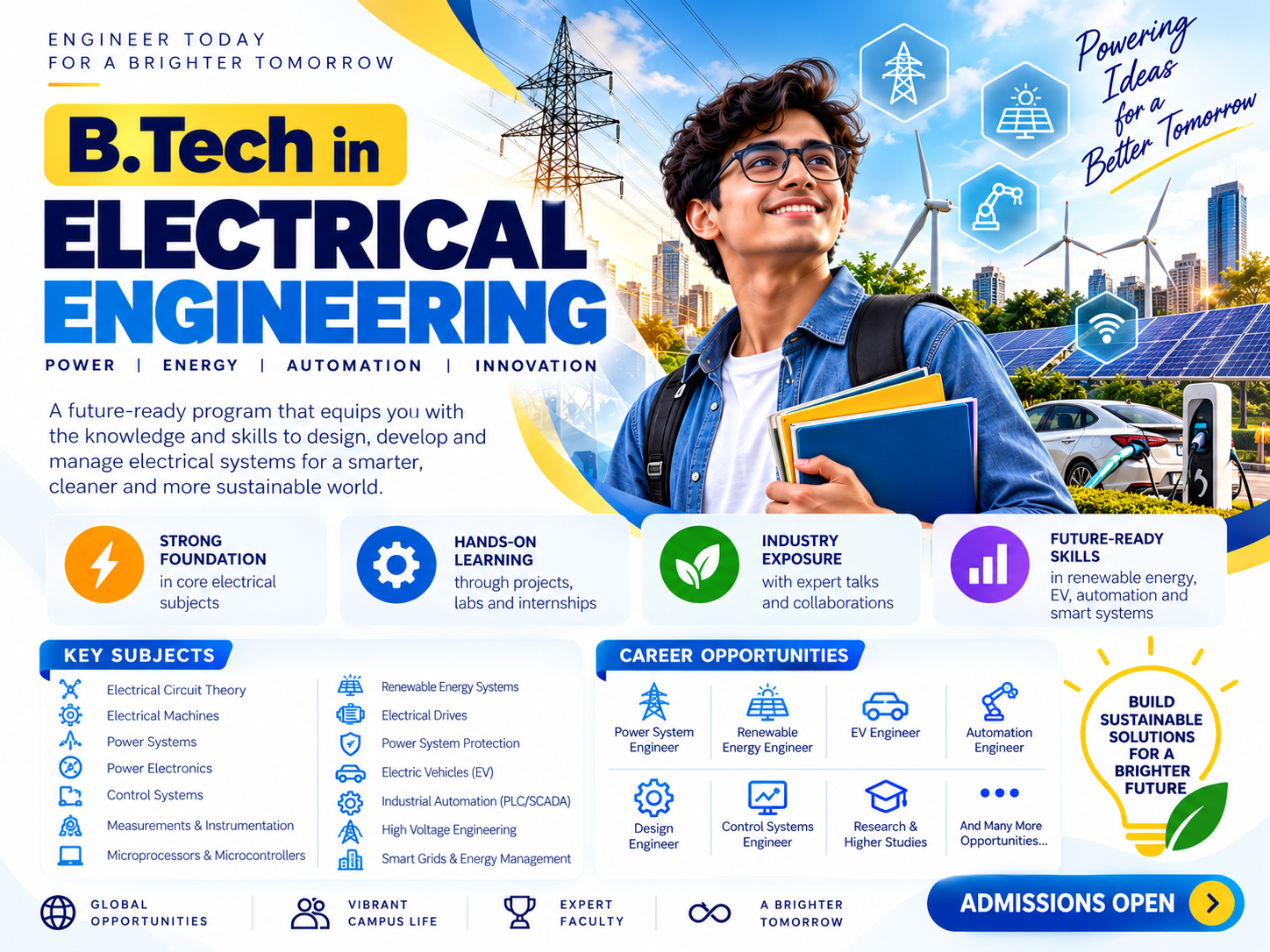
B.Tech in Electrical Engineering is a four-year undergraduate engineering programme focused on electrical power, electrical machines, power systems, control and automation, power electronics, renewable energy, electric vehicles, industrial systems and modern energy technologies. The programme develops strong skills in designing, operating, controlling and maintaining electrical systems, while opening career pathways in power generation and transmission, renewable energy, EVs, automation, electrical design, manufacturing, industrial systems, government/PSU sectors and research.
Build the engineering systems that power industries, cities, transportation, renewable energy and the technologies of tomorrow.
B.Tech in Electrical Engineering combines electrical circuits, machines, power systems, power electronics, control, automation, renewable energy and emerging technologies such as electric vehicles and smart grids.
Electrical Engineering is one of the broadest engineering disciplines, covering the generation, transmission, distribution, conversion, control and efficient use of electrical energy.
The programme starts with mathematics, physics, electrical circuits and engineering fundamentals and progressively moves into electrical machines, power systems, electronics, control systems, power electronics and industrial applications.
Students can then build specialised expertise in renewable energy, electric vehicles, smart grids, automation, industrial electrical systems, energy management and advanced electric drives.
Electrical Engineering is no longer limited to traditional power plants. It connects directly with renewable energy, electric vehicles, automation, power electronics and intelligent energy systems.
Understand how electricity is generated, transmitted, distributed and managed.
Learn motors, generators, transformers and electromechanical energy conversion.
Work with converters, inverters and controlled electrical power systems.
Explore solar, wind, energy conversion, storage and sustainable power systems.
Develop knowledge of EV powertrains, charging, batteries and electric drives.
Build skills in control systems, PLC, SCADA, instrumentation and industrial automation.
The exact syllabus varies by university, but a typical Electrical Engineering curriculum includes the following core and advanced areas.
Calculus, differential equations, linear algebra, probability and mathematical methods used in engineering.
Network theorems, AC/DC circuits, transient analysis, resonance and electrical network fundamentals.
Measurement techniques, instrumentation, sensors, errors and electrical testing.
Transformers, DC machines, induction motors, synchronous machines and their applications.
Generation, transmission, distribution, load flow and modern power-system operation.
Power semiconductor devices, converters, rectifiers, inverters and controlled power systems.
Feedback systems, modelling, stability, controllers and control-system analysis.
Processor architecture, programming, interfacing and embedded control.
Electric motors, drive control, speed control and industrial drive applications.
Relays, circuit breakers, fault analysis and protection of electrical networks.
Solar and wind energy conversion, grid integration and sustainable power systems.
EV architecture, batteries, electric drives, charging systems and hybrid powertrains.
High-voltage insulation, testing, breakdown mechanisms and HV systems.
Harmonics, voltage disturbances, power quality improvement and FACTS technologies.
Industrial power distribution, electrical equipment, safety and industrial system design.
Energy efficiency, auditing methodologies, conservation and energy management.
Dynamic behaviour, stability and advanced control of electrical power systems.
Digital controllers, discrete systems, computational control and modern automation.
Students can build deeper expertise around the technologies and industries they want to enter.
Generation, transmission, distribution, protection and grid management.
Solar, wind, energy conversion, storage and sustainable power.
EV powertrains, batteries, charging and electric drive systems.
Converters, inverters, drives and advanced power conversion.
PLC, SCADA, instrumentation, robotics and industrial automation.
Smart grids, energy management, storage and intelligent infrastructure.
Practical projects help students convert electrical engineering concepts into real-world engineering systems.
Monitor solar generation, voltage, current, power and energy consumption.
Design a prototype charging and monitoring system for electric vehicles.
Develop an intelligent energy-monitoring system using sensors and connectivity.
Create an industrial automation prototype using PLC logic and sensors.
Build a system to monitor and improve electrical power factor.
Develop controlled motor-starting and speed-control applications.
Electrical Engineering provides multiple routes across core electrical industries and emerging technology sectors.
B.Tech EE → Power Systems → Grid Knowledge → Internship → Power Engineer → Senior Engineer → Project / Grid Specialist
B.Tech EE → Solar/Wind → Power Electronics → Energy Systems → Renewable Energy Engineer → Project Engineer → Energy Specialist
B.Tech EE → Electrical Machines → Power Electronics → EV Systems → Battery/Charging → EV Engineer → EV Systems Specialist
B.Tech EE → Electronics → Converters → Inverters → Drives → Power Electronics Engineer → Senior Specialist
B.Tech EE → Control Systems → PLC → SCADA → Industrial Automation → Automation Engineer → Controls Specialist
B.Tech EE → Electrical Design → AutoCAD → Industrial Systems → Design Engineer → Senior Design Engineer → Consultant
B.Tech EE → Machines → Maintenance → Industrial Systems → Project Engineer → Operations / Maintenance Specialist
B.Tech EE → Specialisation → M.Tech / M.S. → Research → PhD / R&D → Advanced Engineering or Academic Career
Actual compensation varies significantly with company, location, skill set, specialisation, experience and role.
| Experience | Typical Career Stage | Indicative Range |
|---|---|---|
| 0–2 Years | Entry Level | ₹3–₹6 LPA |
| 2–4 Years | Skilled Engineer | ₹5–₹10 LPA |
| 4–7 Years | Mid-Level Engineer | ₹8–₹15 LPA |
| 7–10 Years | Senior Engineer | ₹12–₹22 LPA+ |
| 10+ Years | Lead / Specialist | ₹18 LPA+ |
* Indicative industry-oriented ranges only. Actual salaries depend on employer, geography, experience, skills and role.
Specialise in power systems, power electronics, control, renewable energy or related fields.
Pursue advanced engineering and technology education in India or abroad.
Build advanced expertise in sustainable power generation and energy systems.
Move towards technology management, operations, consulting or business leadership.
Develop advanced research capabilities and pursue R&D or academic careers.
Complement the degree with specialised industry certifications and software skills.
EE is a strong choice for students who enjoy mathematics, physics, machines, technology, practical problem solving and understanding how large-scale systems work.
A progressive approach from engineering fundamentals to industry-ready specialisation.
The discipline is expanding beyond traditional electrical infrastructure into intelligent, sustainable and electrified systems.
Solar, wind, grid integration and sustainable energy systems.
EV powertrains, batteries, charging infrastructure and electric mobility.
Intelligent monitoring, distributed generation and advanced grid management.
PLC, SCADA, robotics and intelligent manufacturing systems.
Efficient power conversion for EVs, renewable energy and modern electrical systems.
Batteries, storage systems and technologies supporting the future energy ecosystem.
Electrical Engineering can take you from power systems and industrial infrastructure to electric vehicles, renewable energy, automation and smart technologies.
Explore B.Tech Electrical Engineering