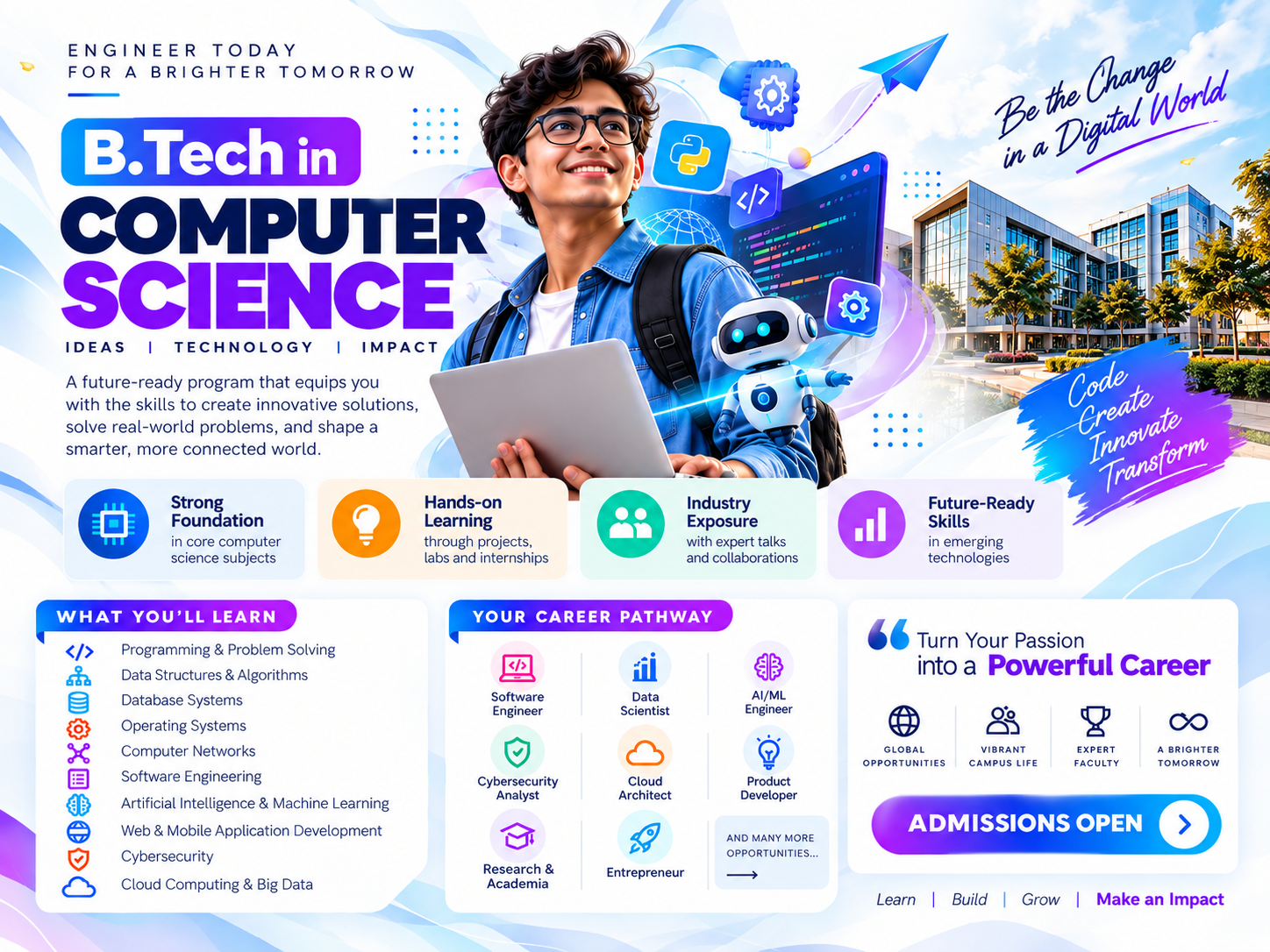
B.Tech in Computer Science is a four-year undergraduate program that develops strong foundations in programming, software development, data structures, algorithms, databases, computer networks, artificial intelligence, and emerging technologies. The course combines theoretical knowledge with practical projects to prepare students for careers in software engineering, IT, data science, cybersecurity, cloud computing, and other technology-driven fields.
B.Tech in Computer Science & Engineering (CSE) is a four-year undergraduate engineering programme designed to develop strong foundations in programming, algorithms, software development, databases, computer networks, operating systems, artificial intelligence and modern computing technologies.
The programme combines theoretical concepts with laboratory work, projects, internships and industry-oriented skills, preparing students for careers across software development, AI & machine learning, data science, cybersecurity, cloud computing, DevOps and technology management.
Computer Science & Engineering is one of the broadest and most versatile engineering disciplines. The programme teaches students how computers work, how software is designed and developed, how data is stored and processed, and how intelligent and scalable digital systems are built.
Students begin with programming and mathematical foundations and progressively move into data structures, algorithms, databases, operating systems, computer networks, software engineering and advanced areas such as artificial intelligence, machine learning, cloud computing and cybersecurity.
The course also provides opportunities to develop practical experience through laboratory sessions, internships, hackathons, technical projects and a final-year project.
A CSE degree can lead to careers in software, data, artificial intelligence, cybersecurity, cloud computing, product development and more.
Students work with technologies that are transforming businesses, healthcare, finance, education, manufacturing and other industries.
Software and technology skills can create opportunities with companies in India as well as international organisations and remote teams.
Technology professionals can progress from entry-level engineering roles to senior engineering, architecture, product and leadership positions.
CSE graduates can build software products, SaaS platforms, mobile applications, technology startups and freelance businesses.
The field provides continuous opportunities to learn emerging technologies such as AI, cloud, blockchain, cybersecurity and advanced data systems.
The exact syllabus varies by university, but a typical Computer Science & Engineering programme covers the following core areas.
Learn programming concepts, problem solving, functions, arrays, pointers, object-oriented programming and software development basics.
Learn arrays, linked lists, stacks, queues, trees, graphs, searching, sorting, recursion and algorithm analysis.
Covers logic, sets, relations, functions, graphs, combinatorics and mathematical concepts used in computing.
Learn relational databases, SQL, database design, normalization, transactions and data management.
Study processes, threads, memory management, scheduling, file systems, synchronization and operating-system architecture.
Understand networking concepts, protocols, TCP/IP, routing, switching, network security and internet technologies.
Learn how processors, memory, instruction sets, digital systems and computer hardware interact.
Covers software development life cycle, requirements, design, testing, version control and project management.
Learn frontend and backend technologies used to build modern websites and web applications.
Introduction to intelligent systems, search techniques, knowledge representation and AI applications.
Learn supervised and unsupervised learning, model development, evaluation and practical machine-learning applications.
Covers security principles, threats, vulnerabilities, authentication, cryptography and secure systems.
B.Tech CSE provides multiple career pathways. Students can choose a specialization based on their interests, technical strengths and career goals.
B.Tech CSE → Programming → DSA → Development Projects → Internship → Software Developer → Senior Software Engineer → Tech Lead / Architect
B.Tech CSE → Python → Mathematics & Statistics → Machine Learning → Deep Learning → AI/ML Engineer → Senior AI Engineer / AI Specialist
B.Tech CSE → Python + SQL → Statistics → Data Analysis → Machine Learning → Data Scientist / Data Engineer / Analytics Specialist
B.Tech CSE → Networking → Linux → Security Fundamentals → Ethical Hacking / Security Tools → Security Analyst → Cybersecurity Engineer
B.Tech CSE → Linux → Networking → Cloud Fundamentals → AWS/Azure/GCP → DevOps → Cloud Engineer → Cloud Architect
B.Tech CSE → GATE / Higher Studies → M.Tech / MS → Research / Teaching / Advanced Engineering → PhD / Research Career
Graduates can work across IT services, software product companies, startups, consulting firms, financial services, e-commerce, healthcare, telecommunications and other technology-driven industries.
Design, develop, test and maintain software applications.
Build scalable software systems and engineering solutions.
Develop responsive websites and web applications.
Build and maintain Android, iOS or cross-platform applications.
Analyse data and create insights for business decisions.
Apply statistics and machine learning to complex data.
Build, train and deploy machine-learning systems.
Monitor systems and help protect organisations from cyber threats.
Design and manage cloud-based infrastructure and services.
Automate software delivery, deployment and infrastructure operations.
Manage enterprise computing infrastructure and systems.
Test software applications and improve product quality.
Salary depends on technical skills, college, location, internship experience, interview performance, company, specialization and market conditions. The following figures are indicative ranges rather than guaranteed salaries.
| Career Stage | Typical Experience | Indicative Salary Range |
|---|---|---|
| Entry Level / Fresher | 0–2 Years | ₹3 – ₹6 LPA |
| Skilled Software Engineer | 2–4 Years | ₹5 – ₹10 LPA |
| Mid-Level Engineer | 4–7 Years | ₹8 – ₹18 LPA |
| Senior Engineer | 7–10 Years | ₹15 – ₹30 LPA+ |
| Lead / Architect | 10+ Years | ₹25 LPA+ |
Strong programming, DSA and development skills can improve entry-level opportunities.
Strong Python, statistics, SQL and machine learning skills are valuable.
Advanced mathematical, programming and ML skills can lead to specialized roles.
Networking, Linux, security tools and certifications can strengthen career opportunities.
Cloud certifications and practical infrastructure experience can improve employability.
SQL, Python, data pipelines, databases and cloud technologies are important skills.
Specialise in Computer Science, AI, Data Science, Cybersecurity, Software Engineering or related areas.
Pursue advanced computer science and technology specialisations in India or abroad.
Combine technical knowledge with business, product, consulting or management careers.
Suitable for students interested in advanced research, academia and specialised technology research.
Students can pursue certifications in cloud, cybersecurity, data, AI, DevOps and other technologies.
A Computer Science graduate can also choose entrepreneurship instead of a conventional employment pathway. Technical knowledge can be used to create software products, SaaS platforms, mobile applications, AI solutions, cybersecurity services, web agencies and technology startups.
Programming, mathematics, computer fundamentals, communication skills and basic problem solving.
Data Structures, Algorithms, DBMS, Operating Systems, Networks and Object-Oriented Programming.
Explore AI/ML, Data Science, Cybersecurity, Cloud, Web Development, Mobile Development or other areas.
Internship, major project, coding practice, interview preparation, resume building and placement preparation.
A B.Tech in Computer Science & Engineering can provide a strong foundation for a wide range of technology careers. The strongest outcomes come from combining the degree with practical skills, real-world projects, internships and continuous learning.
Explore AdmissionB.Tech in Computer Science & Engineering is a 4-year undergraduate engineering programme that covers programming, data structures, algorithms, databases, operating systems, computer networks, software engineering, AI, machine learning and other computing technologies.
The standard duration of the B.Tech in Computer Science & Engineering programme is 4 years, divided into 8 semesters.
Generally, students who have completed Class 12 with Physics, Chemistry and Mathematics (PCM) from a recognized board can apply. Specific eligibility and minimum marks may vary by university or admission authority.
Yes. Mathematics is an important foundation for Computer Science and is generally required for admission to B.Tech CSE programmes.
Major subjects typically include Programming, Data Structures & Algorithms, Database Management Systems, Operating Systems, Computer Networks, Computer Architecture, Software Engineering, Artificial Intelligence, Machine Learning, Cybersecurity and Web Technologies.
Yes. CSE provides a strong foundation for AI and Machine Learning. Students should additionally develop skills in Python, statistics, mathematics, machine learning, deep learning and AI frameworks.
Yes. Students can specialise in cybersecurity by developing knowledge of computer networks, Linux, ethical hacking, cryptography, security tools and information security.
Yes. Computer Science provides a broad range of career opportunities because software and digital technologies are used across industries such as finance, healthcare, education, e-commerce, manufacturing and telecommunications.
A strong roadmap is: Year 1: Programming & fundamentals → Year 2: DSA, DBMS, OS & Networks → Year 3: Specialisation + projects → Year 4: Internship + major project + placement preparation.